2020-07-23
【Stanford University】FSI’s Incoming Center Fellow Oriana Skylar Mastro Discusses Chinese Ambitions, Deteriorating U.S.-China Relations
【史丹佛大學官網】FSI 即將上任的中心研究員 Oriana Skylar Mastro 討論中國的雄心與不斷惡化的美中關係。
https://reurl.cc/ppdpKd節錄...
Mastro, whose appointment as a Center Fellow at Shorenstein APARC begins on August 1, considers the worsening relations between the world’s two largest economies, analyzes Chinese maritime ambitions, and talks about her military career and new research projects.
Mastro 將於 8 月 1 日開始擔任 Shorenstein 亞太研究中心(APARC) 的中心研究員。她在文中探討全球兩大經濟體之間日益惡化的關係,分析中國的海洋戰略雄心,並談到她的軍事生涯與新的研究計畫。
U.S.-China relations have been deteriorating at an alarming speed, and as distrust grows on both sides, it is unclear how to stop the downward spiral. What does China want and how can we best assess Chinese intentions?
美中關係正以令人憂心的速度惡化,隨著雙方的不信任感不斷加深,如何阻止這種向下螺旋式惡化仍不明朗。究竟中國想要什麼?我們又該如何最好地評估中國的意圖?
This is a key question on the research agenda of East Asian security expert Oriana Skylar Mastro, FSI’s newest Center Fellow. Mastro, an assistant professor of security studies at Georgetown University’s Edmund A. Walsh School of Foreign Service, will begin her appointment at FSI on August 1 and be based at the Shorenstein Asia-Pacific Research Center (APARC), where she will continue her research on Chinese military and security policy, Asia-Pacific security issues, war termination, and coercive diplomacy. She will also work with the Center for International Security and Cooperation (CISAC), and teach students in both the CISAC Honors program and the Ford Dorsey Master’s in International Policy program.
這正是東亞安全專家、FSI 最新中心研究員 Oriana Skylar Mastro 研究議程中的關鍵問題。Mastro 是喬治城大學 Edmund A. Walsh 外交學院 的安全研究助理教授。她將於 8 月 1 日開始在 FSI 任職,並以 Shorenstein 亞太研究中心(APARC) 為基地,在那裡繼續研究中國的軍事與安全政策、亞太安全議題、戰爭終結以及強制外交。她也將與 國際安全與合作中心(CISAC) 合作,並在 CISAC 榮譽課程以及 Ford Dorsey 國際政策碩士課程 中授課。
Here, Mastro discusses Chinese ambitions and the rapidly increasing tensions in U.S.-China relations; talks about her military career and new research projects; shares how she first became interested in East Asian security issues as a Stanford undergraduate student; and even reveals some things we don’t know about her.
在這篇訪談中,Mastro 討論中國的戰略雄心以及迅速升高的美中緊張關係;談到她的軍事生涯與新的研究計畫;分享她在史丹佛大學就讀本科時如何首次對東亞安全議題產生興趣;並透露一些外界不太知道的個人事情。
You have argued in your writings that although China does not want to usurp the United States’ position as the leader of the global order, its strategic goal in the Indo-Pacific region is nearly as consequential. Why is it so? What do you foresee for Chinese aims and the U.S.-China rivalry as we near the U.S. presidential election?
你在著作中曾主張,儘管中國並不想篡奪美國在全球秩序中的領導地位,但它在印太地區的戰略目標幾乎同樣具有重大影響。為什麼會這樣?隨著美國總統選舉臨近,你如何看待中國的目標以及美中競爭的發展?
Mastro: My claim is that China doesn't want to replace the United States but rather displace the United States. It’s an important distinction because it’s become popular to assume that China wants to have everything that we, the United States, have and that its view of power is the same as ours. But if you look throughout history, every time a country rises, it exercises its power differently. The United States, for example, didn't build colonies because Great Britain had had colonies. It is equally unlikely to assume that China is going to build a global military and engage in foreign military interventions.
Mastro:我的主張是,中國並不是想取代美國,而是想排擠美國。
這是一個重要的區別,因為現在很流行的一種假設是:中國想擁有美國所擁有的一切,而且它對權力的理解與我們相同。但如果回顧歷史,每當一個國家崛起時,它運用權力的方式往往都不同。例如,美國並沒有因為英國曾建立殖民地,就去建立自己的殖民帝國。同樣地,假設中國會建立全球性的軍事體系並進行海外軍事干預,也未必合理。
我們往往根據自己的經驗來推測中國想要什麼、以及它會如何達到目標,而這些假設往往是不正確的。Oriana Skylar Mastro
Therefore, I argue that China doesn't want to dominate the world. This doesn’t mean that its ambitions are limited, but rather that it thinks that the U.S. in-depth global involvement is an ineffective and costly way of doing business. Outside of Asia, China relies mainly on political and economic influence to ensure that no one goes against its interests. It is only in Asia where China’s military goals are problematic for the United States and where it wants to dominate and see the U.S. military less active. Again, this isn't due to lack of ambition: from China’s viewpoint, whoever dominates Asia, the world’s most dynamic and economically important region, is a superpower, just like whoever dominated Europe during the Cold War would have been a superpower. In short, I think we make assumptions about what China wants and how it will get there based on our own experiences, and those tend to be incorrect.
因此,我認為中國並不想統治整個世界。這並不意味著中國的雄心有限,而是它認為美國那種深度介入全球事務的方式既低效又昂貴。
在亞洲之外,中國主要依靠政治與經濟影響力來確保沒有國家違背其利益。只有在亞洲,中國的軍事目標才會對美國造成問題,在這裡中國希望取得主導地位,並讓美軍活動減少。再次強調,這並不是因為中國缺乏雄心:在中國看來,誰主導亞洲這個全球最具活力且最重要的經濟區域,誰就是超級強國,就像在冷戰時期如果某個國家主導歐洲,它也會是超級強國一樣。簡而言之,我認為我們常常根據自身經驗來推測中國的目標以及它達成目標的方式,而這些推測往往是錯誤的。As for what’s ahead for the U.S.-China relationship and the coming presidential election, I think it’s a misconception to interpret the frictions between the two countries as stemming from the Trump administration. There are aspects of Chinese behavior that both the Republican and Democratic parties find problematic and I believe we will see a tougher policy towards China, regardless of who wins the election. A Democratic president might be less willing to risk confrontation with the Chinese the way the Trump administration is, but either way, I see increased tensions between the two sides as the norm for the next several years.
至於未來的美中關係以及即將到來的美國總統大選,我認為把兩國之間的摩擦解釋為源自川普政府是一種誤解。中國的一些行為讓共和黨與民主黨都認為存在問題,因此我相信無論誰贏得選舉,美國對中國的政策都會變得更強硬。民主黨總統或許不像川普政府那樣願意冒著對抗風險與中國衝突,但無論如何,我認為未來幾年兩國關係緊張將成為常態。
In your recent testimony on China’s maritime ambitions before the House Committee on Foreign Affairs, you distinguish between China's aims in its near seas and far seas. How do these intentions differ and why is it important to make the distinction between them?
在你最近於美國眾議院外交事務委員會就中國海洋雄心作證時,你區分了中國在「近海」與「遠海」的目標。這些目標有何不同?為什麼區分它們很重要?
Mastro: In the near seas — the South China Sea (SCS) and the East China Sea (ECS) — China is concerned with sovereignty, which is absolute control of these waters, and with regional hegemony. In the far seas — the Indian Ocean and beyond — China aims to operate, but it doesn’t aspire to exclude others from doing so. In these waters, China's ambitions are driven primarily by the desire to protect its strategic lines of communication and its economic and political interests.
Mastro:在近海 - 也就是南海(SCS)與東海(ECS) - 中國關注的是主權問題,也就是對這些海域的完全控制,以及區域霸權。
在遠海 - 例如印度洋及更遠的海域 - 中國的目標是能夠在那裡活動,但並不打算排除其他國家在那裡活動。在這些海域,中國的雄心主要來自於保護其戰略交通線以及其經濟與政治利益的需要。
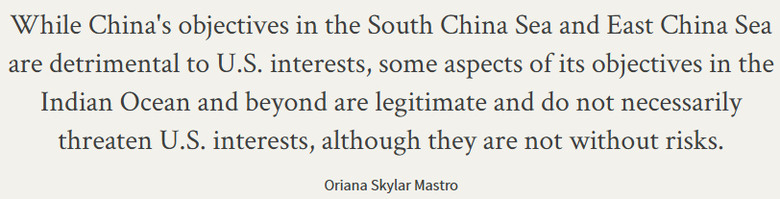
儘管中國在南海與東海的目標對美國利益不利,但中國在印度洋及更遠海域的一些目標是合理的,也不一定會威脅到美國利益,儘管這些目標仍然存在風險。Oriana Skylar Mastro
It’s important to make this distinction for strategy reasons, which goes right to my previous point. There’s a growing sense now that “whatever China does is bad and the United States needs to counter everything China does,” but that's not quite true. While China's objectives in the SCS and ECS are detrimental to U.S. interests, some aspects of its objectives in the Indian Ocean and beyond are legitimate and do not necessarily threaten U.S. interests, although they are not without risks.
出於戰略上的原因,區分這兩者非常重要,這正呼應我之前的觀點。現在越來越多人認為「中國做的任何事情都是壞事,美國必須對抗中國的一切行動」,但這其實並不完全正確。
雖然中國在南海與東海的目標確實對美國利益不利,但中國在印度洋及更遠海域的一些目標是合理的,也不一定威脅到美國利益,儘管仍存在風險。
U.S. policy needs to consider these differences in the degree of threat because prioritization is crucial for strategy. If we are to prioritize our strategies, then we should prioritize countering China’s ambitions in its near seas and try to shape its objectives in the far seas, perhaps through more cooperative policies. Perceiving everything that China does as bad isn’t the right approach to competing with it.
美國政策需要考慮這些威脅程度的差異,因為在戰略上設定優先順序至關重要。如果我們要設定戰略優先順序,就應優先對抗中國在近海的雄心,並嘗試在遠海方面影響中國的目標,也許可以透過更具合作性的政策來實現。把中國所做的一切都視為壞事,並不是與其競爭的正確方式。
------------中略---------------
How did you first become interested in China and East Asian security issues, and what made you pursue a military career?
你最初是如何對中國與東亞安全問題產生興趣的?又是什麼讓你決定從事軍事生涯?
Mastro: This is a fun topic to talk about at Stanford because it's all thanks to my experiences as an undergraduate student on The Farm. As a freshman, I began learning Chinese, and in the following years, being humanities- and arts-focused, I mainly studied ancient China and Chinese literature. When I returned to campus after a year of intensive study in China, I was looking for a research opportunity and heard about the CISAC Honors Program in International Security Studies. So it was only in my senior year that I took my first course in political science and was exposed to international security studies. I discovered a passion for this topic like nothing else I had studied before. I wanted to learn more and got my first job, at the Carnegie Endowment, researching security issues, and then decided to continue with graduate studies.
Mastro:在史丹佛談到這個話題很有趣,因為這一切都要歸功於我在那裡讀本科時的經歷。
大一時我開始學中文,接下來幾年因為主修人文與藝術領域,我主要研究的是中國古代史與中國文學。
在中國進行了一年的密集學習之後回到校園,我開始尋找研究機會,並聽說了 CISAC 的國際安全研究榮譽課程。直到大四時,我才上了第一門政治學課,並首次接觸國際安全研究。我發現自己對這個領域產生了前所未有的熱情。我想進一步深入了解,於是得到第一份工作,在 卡內基國際和平基金會(Carnegie Endowment) 研究安全議題,之後決定繼續攻讀研究所。
------------中略---------------
What are some of your current research projects and what do you plan to work on at APARC and Stanford at large?
你目前有哪些研究計畫?以及你打算在 APARC 和史丹佛從事哪些研究?
Mastro: My main project is researching a book about what China wants – a framework for understanding how to assess Chinese intentions. This is a policy-relevant book that engages with international relations theory and literature, where understanding state intentions plays a key role. The framework I’m developing assesses information to answer what China’s intentions are in several areas and regarding several cases. There will be chapters on China’s regional ambitions, global ambitions, approach to international institutions, and intentions towards the economic and technological order. As part of this project, you may see me currently publishing works on the South China Sea or the Indian Ocean.
Mastro:我的主要研究計畫是一部關於「中國想要什麼」的書,提出一個理解並評估中國意圖的分析框架。
這本書與政策密切相關,同時也與國際關係理論與相關文獻對話,在這些研究中,理解國家的意圖是核心問題。我正在建立的框架會透過分析各種資訊,來回答中國在不同領域與不同案例中的意圖是什麼。
書中將包含關於中國區域雄心、全球雄心、對國際機構的態度,以及對經濟與科技秩序的意圖等章節。作為這項研究的一部分,你可能會看到我目前發表一些關於南海或印度洋的研究。

中國沒有任何正式的軍事同盟,但這並不代表它沒有與其他國家協調或合作。Oriana Skylar Mastro
Another project, in its beginning stages, focuses on the China-Russia relationship. Here the overarching framework is an attempt to understand state cooperation. This relates to alliances, though the notion of alliances is rather outdated. China doesn't have any alliances, but that doesn't mean it isn’t aligned or working with other countries. The question is what types of cooperation between China and Russia are problematic for the United States and what types are not. Again, we need to prioritize: is it so bad if China and Russia back each other in the UN, or is it worse that they exercise together? I don't know yet, but I think that international relations theory can shed some light on these questions.
另一個仍在初期階段的研究計畫聚焦於中俄關係。這項研究的整體框架是試圖理解國家之間的合作。這與同盟有關,但「同盟」這個概念本身其實已經相當過時。中國沒有任何正式同盟,但這並不代表它沒有與其他國家協調或合作。
問題在於,中國與俄羅斯之間哪些合作形式對美國來說是問題,哪些則不是。我們仍然需要設定優先順序:如果中國與俄羅斯在聯合國互相支持,這真的很嚴重嗎?還是兩國進行聯合軍演更嚴重?我現在還沒有答案,但我認為國際關係理論可以為這些問題提供一些解釋。
.................