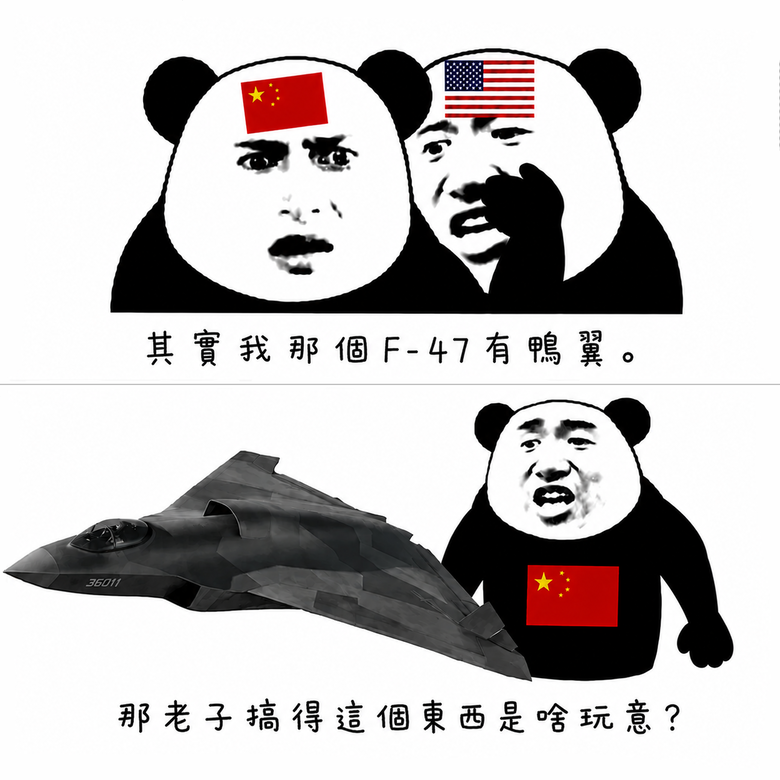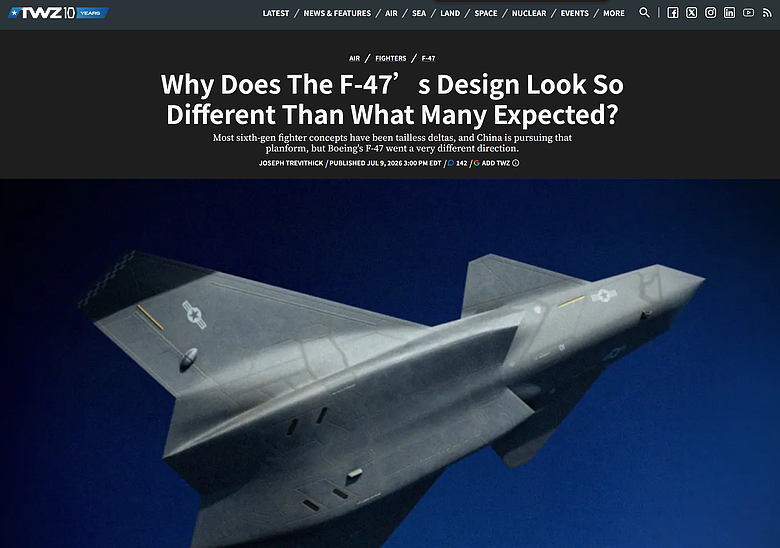
关于鸭翼部分的大段落:
Canards
The presence of canards has been a hot topic of discussion surrounding the F-47, even before Project Fear released its video. Canards were a feature that was visible in one of the official renderings released back in March 2025, and that came as a surprise to many.
Canards do provide additional maneuverability and stability, especially for a delta-wing aircraft, and at high angles of attack. Traditional vertical tails also help with stabilization, so canards could offer further benefits when used in tailless designs. However, they have historically been less than ideal for low observable designs, especially from the frontal aspect, which is of critical importance for the survivability of tactical jets flying into harm’s way. TWZ explored all of this in detail at the time.
The presence of canards in the F-47 rendering, and now on the design in the Project Fear footage said to have been taken near Area 51, together with the rest of what can be seen of their planforms, has also recalled the design of the X-36 uncrewed demonstrator. Also known as the Tailless Fighter Agility Research Aircraft, this X-plane was developed by Boeing’s Phantom Works advanced projects division, and you can learn more about it here.
“I’ve always liked the X-36. I always thought that was a great place to start if you’re going to have a canard airplane,” Cummings told us. “The X-36 had yaw thrust vectoring, so they eliminated the vertical tails, which was really fantastic. So, yeah, I think X-36 would be a good place to start.”
“I suspect the wing would probably be either level or maybe minus two degrees, and the canard would probably be plus 10 degrees,” he added when asked about whether the F-47’s canards might have the same dihedral as the main wings.
“You need that type of separation to really have the canard be extremely effective throughout the envelope of the airplane. In fact, if you look at the Chinese J-20, I think that’s about exactly what the J-20 use[s],” he explained, noting that this kind of configuration is called a “close couple.”
Another head-on look at a J-20, underscoring Cummings’ comments about the angling of the canards relative to the main wings. Chinese internet
“Now, if you’re widespread, you might be less than that, but if you’re close coupled, I would say, plus 10 on the canard, minus two to three on the wing, would be about optimum,” he added.
The degree to which the canards on the F-47 or the design seen in the Project Fear video might be able to articulate is not clear. The canards on the J-20 and many other existing designs have a wide range of motion up and down, and can deflect asymmetrically.
This picture of an unpainted Chinese J-20 fighter offers a good look at its canards and their ability to articulate. Chinese internet
“The original LockMart [Lockheed Martin] design for CALF [the Common Affordable Lightweight Fighter], pre-JSF [Joint Strike Fighter], was a canard,” Bill Sweetman, a long-time aviation journalist, also told TWZ. “You might want to lock the foreplane in cruise to avoid gaps, but all very doable. The key is to maintain the edge alignments.”
CALF was merged with the Joint Advanced Strike Technology (JAST) effort in the early 1990s to create the JSF program, which led to the F-35. CALF had also evolved from earlier Defense Advanced Research Projects Agency (DARPA) efforts called Advanced Short Takeoff and Vertical Landing (ASTOVL) and STOVL Strike Fighter (SSF), which began in the 1980s.
A Lockheed subscale test vehicle from the ASTOVL/SSF era, which fed into the CALF program. Public Domain
“As for range – might be a toss-up. A delta [wing] gives you huge capacity but a lot of wetted area, and a canard might trim differently in the cruise,” Sweetman also noted, highlighting a potential link between decisions relating to the wing design and canards.
As mentioned earlier, the still image that Project Fear released had also raised the possibility of the design having not just canards, but a “double-arrowhead” configuration. This sparked new interest in Cummings’ “Christmas Tree” fighter concept, also known as the DP-21. From what is visible in the full video, it seems less likely now that the aircraft has this kind of configuration.
“The only advantage of the Christmas Tree design, the only advantage, is it’s a four-spike design,” Cummings said. “No one, to my knowledge, no one in the history of aerospace has made a four-spike fighter.”
The blueprint of the DP-21 “Christmas Tree” fighter concept. Darold Cummings
It would be “pretty much invisible to radar, as a four-spike airplane,” he added. “In my opinion, it would be a true breakthrough, because it’s never been done.”
“A four-spike design like the B-2 critically has nothing from the head-on aspect, as well as from the rear, which helps immensely with survivability. These are the most critical signature areas, especially the front as the aircraft is heading into hostile territory. Also, because these are located along the path of flight, these spikes can stay consistent on a threat radar as the aircraft moves directly toward or away from the sensor, and are not fleeting in nature like those from the side. So a four-spike aircraft would be very attractive for a tactical fighter meant to persist in contested territory.”
As an aside, Cummings also talked about the value of a canard configuration for a carrier-based fighter, something we have also touched on in the past. Boeing is also in the running to build a sixth-generation fighter for the U.S. Navy, commonly referred to as F/A-XX. The company has released a rendering of its submission to that competition, which shows distinct similarities to the official concept art of the F-47 that has been released to date.
When it comes to a navalized design, canards would be beneficial “mostly for control in landing, and really good control at takeoff,” Cummings said. “If you do it right, you can use the canard in conjunction with thrust vectoring to get everything to do positive lift instead of the wing. You got a wing now that’s giving you pitch-down moment, and now you got a canard giving you pitch-up moment to counter it. So you get the kind of moments you need to get off quickly off the airplane [sic; aircraft carrier] and land in a very, very good aerodynamic situation.”
“Let’s put it this way, we did this same kind of layout on the YF-23, and it worked. Believe it or not, we had a canard version of YF-23. Most people don’t know that, but we actually did, and that was for the Navy, for the same exact reason,” he noted