The Great Capital Regression: Why BATS is the Last Fortress of 18th-Century Asset Perfection
This is an exceptional analysis. To truly value British American Tobacco (BATS), we must deconstruct the "Trinity of Profit" through a historical lens. In terms of pure business model integrity, the AI era represents a regression in capital efficiency compared to the 18th-century Industrial Revolution.
1. The "Red Queen’s Race" and the Fallacy of the Shovel-Seller Many justify AI investment by claiming "it's better to sell shovels (GPUs) than to dig for gold." This is a fatal misunderstanding of the current capital cycle: The Shovel-Seller’s Trap: In the 19th-century gold rush, iron shovels were durable and generic. Today’s AI "shovels" have a functional half-life of only 36 months. More importantly, NVIDIA’s margins are merely a "pre-paid tax" on the gold rush. When the gold (AI output) becomes a zero-marginal-cost commodity, the miners will stop buying expensive shovels. You cannot sell premium tools to an industry that is collectively losing money. Survival Capex: The AI industry is chasing a "Wealth Perpetual Motion Machine." Every cent of profit is immediately consumed by the need to buy newer shovels just to maintain a competitive parity that evaporates by the next update. You aren't building a factory; you are feeding a furnace that melts its own tools. The Cotton Mill (18th Century): Contrast this with the Cotton Mill owner. He purchased cast-iron looms that lasted 30 years. He was a Master of Assets, whereas the shovel-seller and the gold-digger in the AI era are both Slaves to Depreciation. The BATS Advantage: BATS inherits the Cotton Mill logic. Once the NGP platform is scaled, the nicotine molecule requires zero R&D. It is a stable asset yielding massive FCF without the "Shovel-Seller’s" treadmill of constant reinvestment.
2. The Attention Ceiling vs. The Biological Lock The AI Dilemma: AI generates infinite supply (content) to compete for a finite demand (24 human hours). When intelligence becomes a commodity, the value of the "gold" drops faster than the cost of the "shovels." This is a thermodynamic death spiral for capital. The BATS Moat: BATS does not compete for fleeting attention; it secures a "Physiological Lock." It bypasses the "Attention Wall" by digitizing a 200-year-old biological habit. You don’t need to sell a new shovel every year when you own the neural land the gold is buried in.
3. Compliance as a Strategic Weapon: The PMTA Fortress The AI Mirage: Low entry barriers allow "garage startups" to emerge daily, eroding pricing power. In AI, the "Garage" is a threat; in Tobacco, the "Garage" is a federal crime. The BATS Fortress: The extreme difficulty of PMTA approvals has transformed "compliance" into a Moat. BATS sells a "Licensed Habit" protected by the very state barriers that claim to restrict it.
The Verdict: I’ll take the 6% yield of the Biological SaaS (BATS) over the AI treadmill every single time. The 18th-century asset logic remains the only mathematically sound bet in a market blinded by silicon entropy.
Most people are still distracted by regulatory noise, but they’re missing the "fiscal desperation" of the U.S. government.
Look at the May 4th QRA update from the Treasury. They just bumped up this quarter’s borrowing by $79 billion, citing "lower-than-anticipated tax receipts" as the culprit. When the feds can't even collect their planned tax revenue, do you really think they’re going to kill their most reliable "tax-cash cows" like BTI? Not a chance. In a deficit crisis, the Treasury's ledger beats political posturing every time.
Check out the 21.7% Bills Ratio.
We’ve officially breached the TBAC's 20% threshold. The government is essentially funding a long-term debt crisis with short-term high-interest credit cards. This fragility is exactly what will trigger the "meaningful pullback" you’re waiting for.
Bottom line: BTI and others aren't just companies anymore; they are de facto fiscal agents of a bankrupt state. I’m with you—I’ll be waiting for that 21.7% ratio to spark a macro tantrum. That’s the entry point of a lifetime.
Most investors are obsessed with FDA noise, but they fail to see the "fiscal symbiosis" that has turned BTI into a de facto government utility at the state level.
Beyond the $79B federal revenue shortfall I mentioned, one must look at the state balance sheets:
The MSA "Pledge Trap": 46 states are essentially addicted to BTI’s annual checks. Many have securitized these into Tobacco Bonds. The states aren't just regulators; they are leveraged stakeholders who cannot afford to kill their own creditor.
The Efficiency of Sin Taxes: With federal interest payments hitting $734.6B, governors are equally desperate. Tobacco excise taxes are high-margin, zero-collection-cost revenue streams. In this deficit-driven era, you guard the golden goose.
The PMTA Revaluation: Reynolds (BTI) buying CHUC’s PMTAs was a masterstroke. With the Fifth Circuit likely ruling that the FDA overstepped, BTI’s compliant assets are due for an explosive revaluation.
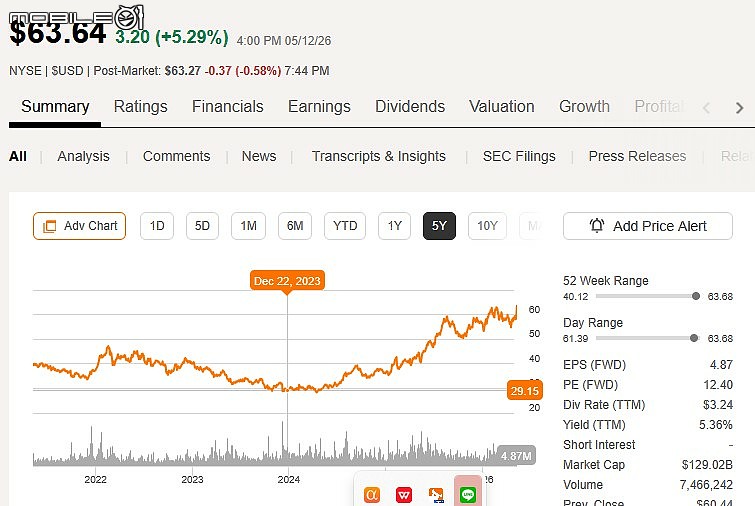
A note on my tactical execution and current dilemma: I just saw BTI jump +$2.16 (+3.71%). It’s a bittersweet feeling; I’m happy to see the value recognized, but frustrated that my dividend reinvestment will now net me fewer shares.
Tomorrow (May 12) is the dividend release. While I face a T+3 to T+7 settlement delay here in Taiwan, I remain unfazed by the price action. People ask if I’ll keep adding at these levels? My answer is the same advice I gave to my sister-in-law: "Yes. Close your eyes and keep buying." Even with the rally, the 21.7% Bills Ratio ensures macro volatility will return. I’ll be watching for that "meaningful pullback" to deploy my delayed dividends.
Bottom line: I trust the 18th-century cast-iron looms over 21st-century banking. As I head out for my morning swim shortly, I’ll be embracing that "rhythmic breathing" — the same calm pace required to navigate these debt-heavy waters. As long as the state is broke, this tax-collecting machine is the safest bet in the room.